Strategic issue
Increase processing capacity without adding manual coordination, while retaining control of data and sensitive decisions.
Composite example · no client data
This example combines typical situations. Names, figures and circumstances are fictional or composite: no metric is presented as an observed client result.
Multi-site B2B service company · illustrative situation
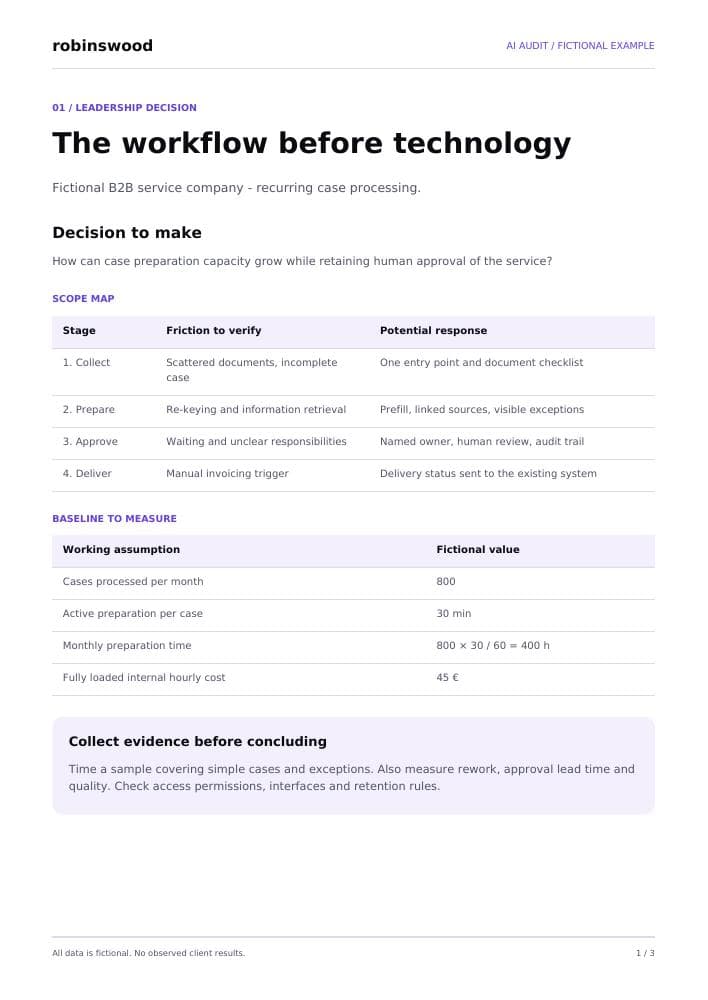
Increase processing capacity without adding manual coordination, while retaining control of data and sensitive decisions.
Request → qualification → collection → preparation → approval → delivery → invoicing.
Information reconstruction and approval between preparation and delivery concentrate waiting time and delay invoicing.
Determine whether the answer is primarily process change, a business tool or a combined path.
Illustrative decision report
Fictional B2B service operation: 800 cases per month, 30 minutes of preparation per case. This example shows how the audit tests a decision; it does not report client results.
The investment combines the published €5,000 audit with a fictional €20,000 implementation. Capacity released is not automatically cash saved: its value depends on how the team reuses it.
| Capacity reused | Monthly value | Net monthly value | Theoretical payback |
|---|---|---|---|
| 0 % | 0 € | -1,800 € | Not reached |
| 30 % | 2,700 € | 900 € | 27.8 months |
| 60 % | 5,400 € | 3,600 € | 6.9 months |
| 90 % | 8,100 € | 6,300 € | 4 months |
Observe cases, measure handoffs and waiting time, confirm data quality, access rights and the responsible sponsor. Validate the hourly cost and a realistic reuse scenario.
30: confirm the baseline and test a limited workflow. 60: compare real cases and adoption with the baseline. 90: decide whether to expand, adjust or stop using observed evidence.
A decision sponsor, a process owner, representative cases and access to the relevant tools. The participation plan and data boundaries are agreed during scoping.
Expected economic gain, adoption conditions and system control must justify what comes next.
Metrics and targets are established during the audit. No composite figure is presented as client proof.